
ISO/IEC 17024 — Personnel Certification Accreditation
Accreditation for Organizations that
Certify Healthcare Professionals
If your organization issues professional certifications in healthcare, ISO/IEC 17024 accreditation gives those credentials international recognition, regulatory defensibility, and a documented path for continuous improvement. ANAB accredits certification bodies across clinical, allied health, and administrative roles.

About the Program
Personnel certification accreditation for healthcare
Competence of healthcare certification bodies directly impacts patient outcomes, workforce quality, and public trust. As demand for validated professional competence continues to grow, certification bodies must demonstrate that their credentials are recognized, credible, and internationally respected.
For decades, ANAB has accredited personnel certification bodies across a wide range of industries. Healthcare remains one of the most credential-intensive sectors we serve and one where confidence in professional competence is especially critical.
Since 2024, the American Nurses Credentialing Center’s Magnet Recognition Program has explicitly recognized ANAB-accredited ISO/IEC 17024 certifications for hospital nursing requirements, reinforcing the growing importance of internationally accredited credentials with healthcare.
ISO/IEC 17024 is the internationally recognized standard for organizations that certify individuals. It establishes requirements for certification program development, psychometrically sound assessments, impartial governance, ongoing competence assurance, and quality management. ANAB accreditation to ISO/IEC 17024 demonstrates that a certification program meets globally recognized benchmark for rigor, credibility, and accountability, providing stakeholders with confidence in the competence of credentialed professionals.
ANAB accredits many of the healthcare industry’s most respected certification organizations, including the ASCP Board of Certification, Cardiovascular Credentialing International, Inteleos, and the Healthcare Sterile Processing Association. Our extensive experience across clinical, allied health, and healthcare support professions gives us a practical understanding of the challenges certification bodies face. We work with organizations to help them achieve ISO/IEC 17024 accreditation efficiently while maintaining the integrity and mission of their certification programs.
Whether you are seeking accreditation for the first time or exploring how ISO/IEC 17024 accreditation can complement existing NCCA recognition, ANAB can help you strengthen the credibility, recognition, and impact of your certification program. Explore the resources on this page to learn more.
Program Scope
Healthcare roles covered under ISO/IEC 17024
ANAB accredits certification schemes across the full spectrum of healthcare roles, including clinical, allied health, and administrative. If your certification body operates in any of these areas, ISO/IEC 17024 accreditation may be applicable to your programs.
|
Clinical |
Allied Health |
Administrative |
|---|---|---|
|
|
|
|
|
|
|
|
|
|
|
|
|
|
|
|
|
|
|
ISO/IEC 17024 — Personnel Certification Accreditation
What Accreditation Under this Standard Requires
ISO/IEC 17024 sets the framework for trustworthy, defensible personnel certification. For healthcare certification bodies, four requirements are especially consequential.
Impartiality
Trust in a certification begins with impartial decision-making. ISO/IEC 17024 requires certification bodies to establish formal governance structures, including mechanisms for managing conflicts of interest and overseeing impartiality. These safeguards help ensure that certification decisions are based solely on demonstrated competence, free from influence by training providers, employers, or other interested parties.
Exam validity
Assessments must accurately measure the competencies required for professional practice. ISO/IEC 17024 requires certification bodies to conduct job task analyses, apply psychometrically sound assessment methods, and regularly evaluate exam performance data. Together, these requirements help ensure that certification decisions are based on demonstrated competence and that credentials remain relevant, credible, and defensible over time.
Transparency
Certification requirements, processes, and decisions must be clearly documented, consistently applied, and accessible to stakeholders. ISO/IEC 17024 requires certification bodies to provide transparent information about eligibility criteria, assessment methods, certification policies, and appeals procedures. This openness promotes fairness for candidates while giving employers, regulators, and the public confidence in the integrity and consistency of certification decisions.
Ongoing assurance
Certification is not a one-time achievement. ISO/IEC 17024 requires certification bodies to establish processes for recertification, ongoing competence assessment, and continued oversight of credential holders. These requirements help ensure that certified professionals remain current as knowledge, technologies, and professional practices evolve.
Who This Serves and How
ISO/IEC 17024 accreditation delivers value across the healthcare ecosystem, reaching the certification bodies that pursue it, the employers and regulators who rely on it, the professionals who hold accredited credentials, and ultimately the patients they serve.
Certification bodies
ANAB accreditation gives certification bodies international market access (credentials recognized in more than 100 countries under the Global ACI’s multilateral recognition arrangement) and a structured framework for strengthening exam design, governance, and impartiality over time.
Employers and regulators
Employers and regulators get objective, third-party proof that credentialed staff have demonstrated tested competence rather than simply completed a training course, giving them a documented basis for hiring decisions, audits, and payer compliance.
Healthcare professionals
For credential holders, accreditation means their certification carries international recognition rather than a domestic benchmark alone, supporting career mobility and standing with employers who recognize the standard’s rigor.
Patients and the public
Ultimately, it’s what stands behind patient safety: verified, continuously maintained competence translates to a more consistent, reliable standard of care.
The pathway to accreditation
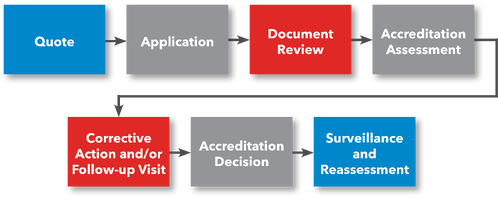
The accreditation process is structured and well-documented. Most healthcare certification bodies are further along than they expect. Existing certification infrastructure, exam development processes, and governance structures typically satisfy the majority of ISO/IEC 17024 requirements. Accreditation is usually refinement, not reinvention.
Global Alignment
Alignment with national and global initiatives
ISO/IEC 17024 accreditation supports healthcare workforce goals shared by major national and international bodies, an increasingly important consideration as healthcare systems become more interconnected.
U.S. HHS & HRSA
ISO/IEC 17024 accreditation advances HHS and HRSA workforce development priorities by providing a rigorous, internationally recognized framework for competency-based certification, particularly relevant for rural health, underserved populations, and allied health workforce programs.
World Health Organization
WHO global health workforce frameworks emphasize cross-border competence recognition and standardized credentialing. ISO/IEC 17024 is the internationally accepted standard most directly aligned with those objectives, supporting workforce mobility across countries and health systems.
ISO/CASCO
ISO/IEC 17024 was developed and is maintained by ISO’s Committee on Conformity Assessment (CASCO), which sets global best practices for accreditation and certification. ANAB is a signatory to the International Accreditation Forum’s multilateral recognition arrangement under this framework.
Find ANAB-accredited healthcare certification bodies
ANAB accredits healthcare certification bodies under ISO/IEC 17024 across a broad range of specialties, including clinical laboratory science, cardiovascular credentialing, sterile processing, neurodiagnostics, behavioral analysis, and more. Search the full directory to explore accredited programs, certification scopes, and accreditation details.